Covid-19 in Argentina
Yin Shan Ho
9/12/2021
Introduction

When thinking of Argentina, football is the word first come up to my mind. Up to now, I can still remember the time that I first knew the Argentine football team in the 2006 FIFA World Cup held by Germany. It was the first time that Lionel Messi played in the FIFA World Cup. Also, it was the first time that I had watched the whole match when Argentina hammered Serbia and Montenegro 6–0 in the group stage. It left me a strong impression to their team and kept on watching their matches til now. I always wanted to watch a match hosted by Argentina, to join them, to cheer them up and feel their fans’ enthusiasm. However, it is difficult to archive under the pandemic situation. Especially when I saw the news that Argentina had a great number of confirmed. Then, what is the actual situation of COVID-19 there? The following contents will explore the covid-19 data in Argentina.
Data description
There are totally two data set used in this blog. The first one is the global cases information of the coronavirus. The second one is the global status of vaccinations. Both of them were downloaded from github. The coronavirus dataset is from RamiKrispin’s github Resitory. The original data is maintained by coronavirus package. The raw data contains 492378 rows and 7 columns of data. The clean data description is as follow.
| Number | Variable | Data Type | Description |
|---|---|---|---|
| 1 | date | Date | The date reported |
| 2 | province | Character | Counrty code |
| 3 | country | Character | Country name |
| 4 | lat | Double | Region of country in WHO |
| 5 | long | Double | Daily new cases |
| 6 | type | Character | Cumulative cases |
| 7 | cases | Nmeric | Daily new deaths |
Whereas the vacciation data set is from owid’s githu Repository. The original data is maintained by COVID-19 Data Repository by the Center for Systems Science and Engineering (CSSE) at Johns Hopkins University. While the raw contains 47026 rows and 14 columns. The clean data description is as follow.
| Number | Variable | Data Type | Description |
|---|---|---|---|
| 1 | date | Date | The date reported |
| 2 | people_vaccinated | Numeric | Number of people vaccinated at least 1 dose |
| 3 | people_fully_vaccinated | Numeric | Number of people fully vaccinated |
The data sets are up to September 11, 2021. While both of these two data sets are still updating daily, you can check on the the latest data from clicking the hyperlink above.
Situation in South America
Overview situation of the continent
Based on the map above, it is found that, the total number of cases confirmed is pretty high in the whole continent. The highest number is found in Brazil with 21 millions, whereas Argentina is the second highest in the continent with 5 millions total number of cases confirmed. While the lowest was found in Guyana located in the Northern part of South America.
[NOTE: The map is interactive, feel free to move around and look for more information!]
Population adjusted number of confirmed
| Ranking | Country | Number of confirmed |
|---|---|---|
| 1 | Argentina | 127,674 |
| 2 | Uruguay | 110,623 |
| 3 | Colombia | 107,979 |
| 4 | Brazil | 105,611 |
| 5 | Chile | 99,003 |
| 6 | Peru | 73,115 |
| 7 | Suriname | 68,726 |
| 8 | Paraguay | 65,641 |
| 9 | Bolivia | 50,604 |
| 10 | Guyana | 35,973 |
| 11 | Ecuador | 34,670 |
| 12 | Venezuela | 12,932 |
However, the total number of the cases confirmed may not be accurate enough to describe the seriousness of the situation as the higher number of confirmed maybe due to the higher population. So, the number of the confirmed cases was adjusted base on the population in the South American countries. After adjustment, it is found that, the number of confirmed cases is the highest in the continent by 127,674 per million population which indicates that three are around 13% of the Argentine population had confirmed to be infected by the COVID-19.
Situation in Argentina
Trend of daily cases
It is found that there are totally 3 waves of the coronavrius cases confirmed increases. The first wave started from June 2020 and reached maximum at mid October 2020. While the second wave started right after the first wave in mid December 2020, however it is less serious compare to the last wave started in March 2021 when the mutant virus started to spread around the world. This also caused the third wave of global pandemic. Luckily, a decreasing trend is observed from June 2021. Even the daily confirmed rate is still around 3000, it is comparatively better compare to the highest period with 40000 daily confirmed in late May 2021!
Trend of Vaccination Status
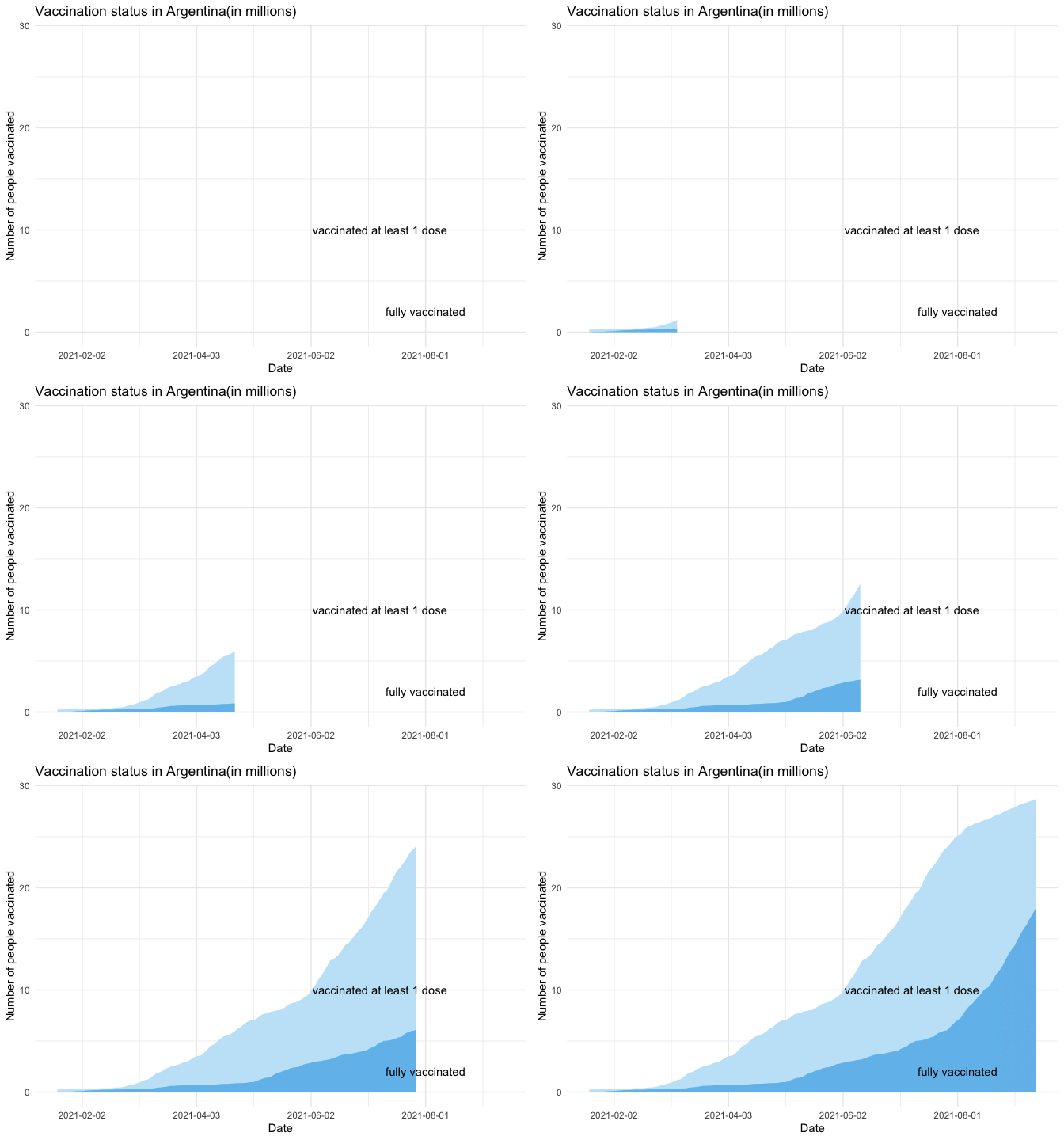
It is found that the there was a sharp increase to the trend of people injected at least 1 dose of the vaccinations. Moreover, steeper trend of increase in people vaccinated at least 1 dose as well as the larger proportion of people fully vaccinated were observed from June 2021. This also explained the effectiveness of the vaccines as there was a great decrease in the number of confirmed cases since then.
References
Argentina: WHO Coronavirus Disease (COVID-19) Dashboard With Vaccination Data. (WHO). Retrieved from https://covid19.who.int/region/amro/country/ar
Rami Krispin and Jarrett Byrnes (2021). coronavirus: The 2019 Novel Coronavirus COVID-19 (2019-nCoV) Dataset. R package version 0.3.22. https://CRAN.R-project.org/package=coronavirus
Wickham et al., (2019). Welcome to the tidyverse. Journal of Open Source Software, 4(43), 1686, https://doi.org/10.21105/joss.01686
Andy South (2017). rnaturalearth: World Map Data from Natural Earth. R package version 0.1.0. https://CRAN.R-project.org/package=rnaturalearth
Pebesma, E., 2018. Simple Features for R: Standardized Support for Spatial Vector Data. The R Journal 10 (1), 439-446, https://doi.org/10.32614/RJ-2018-009
C. Sievert. Interactive Web-Based Data Visualization with R, plotly, and shiny. Chapman and Hall/CRC Florida, 2020.
Hao Zhu (2021). kableExtra: Construct Complex Table with ‘kable’ and Pipe Syntax. R package version 1.3.4. https://CRAN.R-project.org/package=kableExtra
Garrett Grolemund, Hadley Wickham (2011). Dates and Times Made Easy with lubridate. Journal of Statistical Software, 40(3), 1-25. URL https://www.jstatsoft.org/v40/i03/
Thomas Lin Pedersen and David Robinson (2020). gganimate: A Grammar of Animated Graphics. R package version 1.0.7. https://CRAN.R-project.org/package=gganimate